The first bug ludexel ever found in fabri had nothing to do with games. It was a Python
import. ToolRegistry had a method literally named list(), and thanks to PEP 649’s
deferred annotation evaluation, that method name shadowed the list[dict] type hint on
the same class — a crash that only showed up on an import from outside my own test suite.
The commit that fixed it,
b639850, says it plainly:
“Reported by the ludexel service which couldn’t import fabri.” Fourteen hours after fabri’s
rename from “agent-memory framework” to something with a name, a real product broke it in
a way none of my own passing tests had thought to check.
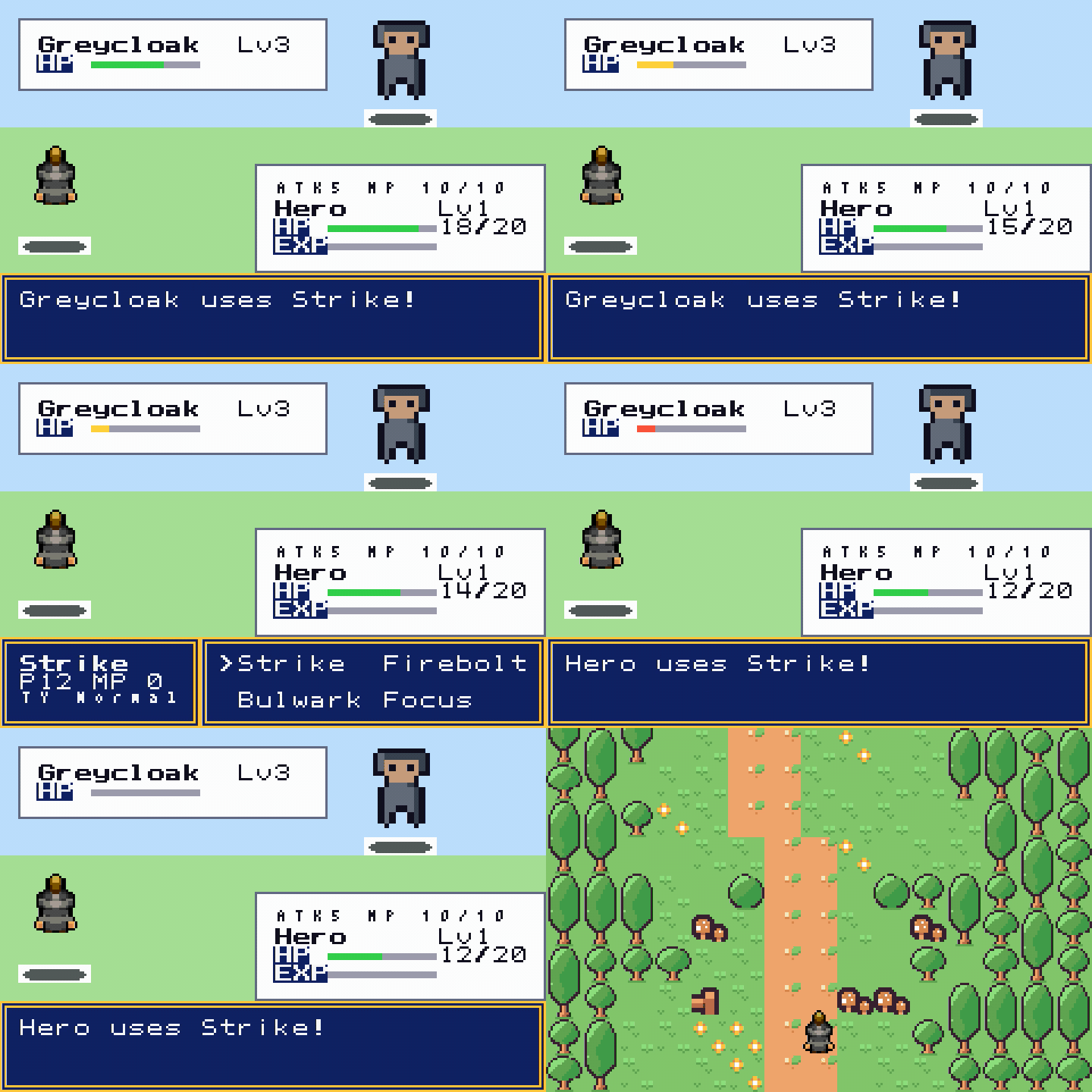
That’s the pattern that repeats for the next three weeks — the actual subject of this post. Building ludexel, an AI-native game studio that turns a prompt into a real Game Boy Advance ROM, taught me fabri faster than staring at fabri ever did. A real product kept giving the framework jobs it could fail at, and each failure was the lesson.
Eviction shipped before anyone filed a complaint
fabri’s memory loop — retrieve, run, mine, dedup, promote, retrieve again — sounds like a
diagram you’d draw before writing code, and for a while it was one. Eviction is the one
piece here I can’t honestly credit to ludexel-gba’s real usage:
memory.max_entries defaults to None (unbounded), and ludexel-gba’s production yaml
never sets it either — the store has never actually hit a cap in a live build. I shipped
the eviction machinery anyway, on the bet that unbounded growth was a ticking bug rather
than a complaint anyone had filed yet.
What shipped is
ca14c33,
“summarize-before-evict strategy for memory eviction” — MemGPT-style recursive
summarization. Every guideline starts out tactical (session-scoped, disposable — the
store’s default kind) and only gets promoted to strategic (protected from eviction)
once a near-duplicate recurs across three separate sessions, so the store doesn’t amplify
a fluke into permanent memory. Eviction chunks the rest in groups of five, compressing each
group into one new tactical guideline; strategic entries are summarized individually
instead so they don’t flatten into the wrong bucket; a plain hard delete is the fallback if
summarizing fails. Five in, one out — a net reduction of four per pass, small enough that
the source comment flags the store can sit “1-2 entries over limit until the next ingest
triggers a follow-up eviction pass.”
Where the COGS number was lying
fabri shipped per-run COGS tracking in v0.5.0 — cost_usd, subagent_cost_usd,
total_cost_usd on every usage event. It felt complete until v0.7.8, “close COGS
leaks in planner, decompose, compress, crashed sub-agents,” found four LLM call sites
burning provider tokens without rolling into the reported total — recorded COGS was
underreporting real spend by roughly 10x on planner-engaged runs. A crashed sub-agent still
cost money; the number just didn’t say so.
Ludexel-gba’s own .agent/fabri_agent.yaml carries the scar tissue directly:
max_steps: 48
max_cost_usd: 8.0        # hard halt -> budget_exceeded

subagent:
  max_steps: 14
  max_cost_usd: 3.0       # domain child needs far less than the orchestrator
That split exists because, without it, every spawn_subagent child inherited the
orchestrator’s max_steps: 48 — a looping domain child could burn the entire run’s budget
on its own (fixed in v0.7.5, commit
0734f15, which added the
agent.subagent budget block). A normal cold build now runs about $2–4.
Measurement follows dependence
For most of fabri’s life, retrieval quality was a vibe. fabri searches memory two ways at
once — dense (embedding similarity) and sparse (an FTS5 keyword index) — and fuses the two
rankings; “hybrid” means both are supposed to be running together. It got measured in
v0.10.0, “Measured retrieval” — the scoping commit says why: “Observability + an offline
eval gate land before any
retrieval-quality upgrade — quality was unmeasured.” That gate (40 guidelines, 24 queries,
real IR metrics, CI floors set at measured-minus-0.05) immediately found a real bug:
_fts5_query was space-joining tokens, and SQLite FTS5 reads a bare space as an implicit
AND, so any multi-word query matched nothing and “hybrid” retrieval silently degraded to
dense-only. Fixing the join pushed hybrid recall@5 — the fraction of relevant results that
actually land in the top 5 — from 0.79 to 0.94.
Retrieval fuses the dense and sparse rankings with Reciprocal Rank Fusion (RRF): each result’s score is 1/(k + its rank) summed across both rankings, so two-way agreement can outrank a result only one search liked. The textbook k=60 is borrowed from web-scale search with pools in the thousands; at fabri’s scale — two short pools, a dozen candidates each — that flattens the formula enough that mere agreement beats the single best match either pool found. Retuning k down to 20 pushed hybrid recall@3 from 0.60 to 0.90.
Both fixes landed the same week fabri went from 0.8.2 to 0.10.0 across the Kiln Road build — a real 5-scene arc, authored end to end by the agent stack — the first stretch where what got retrieved actually mattered to whether a scene got authored right.
The retrospective became the prompt
The single cleanest artifact of the whole loop is a note I wrote myself: “docs(retro)+prompts:
fold Kiln Road v2 retrospective into fabri domains.” The Kiln Road v2 session ran
2026-07-07 to 2026-07-08, roughly 50 commits, structured as “every mistake, missed
verification, and bug from this build, with its root cause and the reusable lesson.” Days
later, that retrospective is literally inside the operating prompts: map.md got a
camera-frame quality contract after three review passes all signed off on maps the user
rejected on sight (“The whole maps are looking bad. Like really bad.”), because reviewers
judged the 32×32 map file instead of the 15×10-tile window the camera actually shows.
The same session produced the sharpest failure in the whole corpus, one I had to fix
myself: the orchestrator prompt had learned to say “New ROM packed — go play it” the moment
validate_content passed — except validate_content only runs the Python generator chain
(chargen, storygen, fontgen, scenegen), never the actual devkitARM compile. An undeclared
ENEMY_SLIME symbol sailed straight through and shipped as “MISSION COMPLETE.” The fix
wasn’t a smarter model — it was removing a claim the prompt had no right to make.
What I shipped next — the no-progress abort, the project_symbols pre-authoring lookup, the
720-second wall-clock backstop — reads like a checklist compiled directly from that bug
list, because it was.
ludexel-app shipped its own Improver on July 3rd: a harness that mines failed runs, ranks
failure classes, and writes a structured brief per class, sharing the docstring constraint
— “NOT an autonomous editor… Nothing here edits code.” Two days later, fabri shipped its
own Improver (fabri ingest, v0.9.2), opening the memory loop to any external log. Same
author, same failure mode, twice — the two codebases never shared a line of code.
What’s still open
I’d like to end on the retrospective-becomes-prompt story — the tidiest proof the loop
works. But onenter_battle_smoke is still quarantined in ludexel-gba’s known
issues — I quarantined it myself, flagged as “story-content drift” — a
battle whose flag layout drifted out from under its own smoke test, sitting there
deliberately unfixed while the other six smokes stay green. The loop that turns ludexel’s
failures into fabri’s features runs both directions, but it doesn’t run on its own — right
now it’s just waiting on me to go fix a battle nobody’s gotten around to yet.